


Many restaurant owners see dynamic prices as a hidden discount or as an extra charge that is hard to explain. That view is too narrow. Used well, dynamic prices can spread out busy times, cover delivery costs, raise order values, use free capacity better and sell perishable stock in a planned way.
So for guests to accept them, these things matter: transparency, minimum and maximum limits, and reliable demand and sales data. A German PwC survey of 1,000 consumers shows how much the context changes the view: 60 % accepted dynamic prices in general, 84 % for seasonal goods, 83 % for slow-selling products and 64 % for certain times of day. The results are not a free pass. They support clearly limited use cases.
You also need to measure correctly. In an analysis by Destatis (the Federal Statistical Office), prices counted as dynamic when at least 3 % of an item’s prices changed during the observed period. Of 2,680 observed products, 22 % changed one to three times within 87 days. The Destatis method for automated price collection gives a useful way of thinking about digital menus and ordering channels. The ten examples below show which trigger fits which restaurant channel, which price logic makes sense and how to measure the decision.
Table of contents
- 1. Time-based pricing for peak hours
- Triggers and suitable channels
- 2. Demand-based pricing
- Use rules, not full automation
- 3. Inventory-based pricing
- 4. Customer-based pricing
- Segments with a clear business purpose
- 5. Menu bundle pricing
- 6. Weather and seasonal pricing
- Use triggers with care
- 7. Payment-method pricing
- Transparency decides acceptance
- 8. Delivery distance and zone pricing
- Zones based on effort, not only on the map
- 9. Quantity discounts and tiered pricing
- Tiers with a minimum margin
- 10. Pre-order and time-slot pricing
- Link lead time to capacity
- Comparison: 10 dynamic pricing examples
- Choosing the right price logic for your business
1. Time-based pricing for peak hours
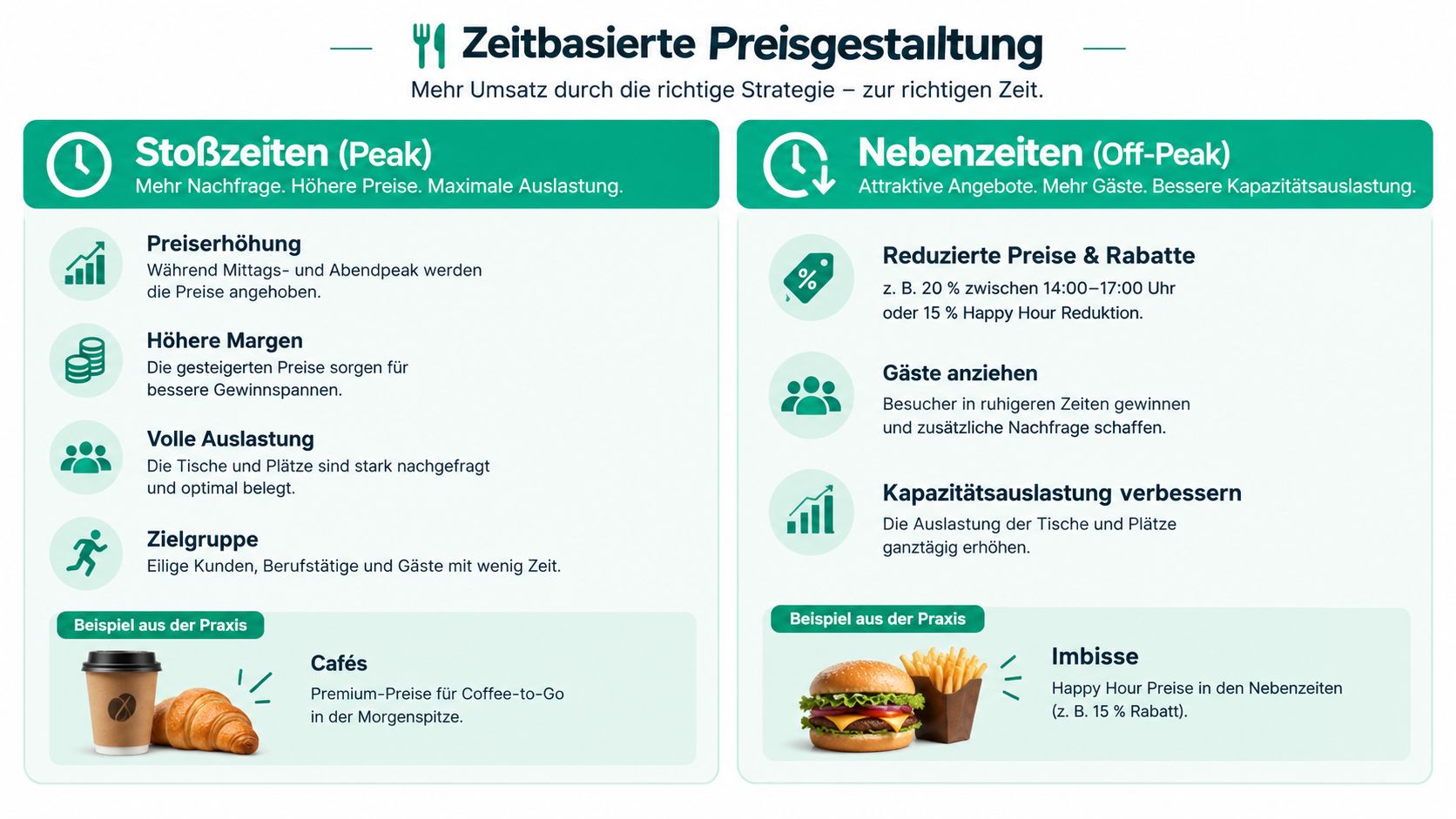
Time-based pricing changes the price according to a fixed time window. For example, a restaurant can bring more guests in the quiet afternoon with a cheaper menu. A café can manage its morning coffee-to-go demand with a premium offer. Guests understand this rule more easily than a sudden price change, because the time and the offer clearly belong together.
A practical model: cheaper dishes between 14:00 and 17:00, a happy hour at a snack bar, or a separate evening menu at very busy times. The business benefit does not come only from a higher price at the peak. What matters is the spread of demand. A free table in a quiet time brings no sales if nobody gets a reason to come.
Triggers and suitable channels
For restaurants, fixed time windows on the digital menu work well. Cafés can show different prices or bundles for morning, lunch and afternoon. Delivery services should check whether an off-peak offer really brings extra orders or only moves orders to another time.
Practical rule: The guest must see the price and the trigger before ordering. A label like “afternoon price” is clearer than an unexplained change in the basket.
With its statistics features, Orderiom can help you spot repeating peaks and weak periods in your demand and sales data. Start by testing only a few time windows and compare guest numbers, order value, capacity use and margin. A price cut only makes sense if it brings extra demand or spreads capacity better.
2. Demand-based pricing
With demand-based pricing, the price reacts to the current number of orders, free seats or delivery capacity. When a delivery service is very busy, it can switch on a clearly shown delivery surcharge. A restaurant can make a menu more attractive in an hour with few bookings, instead of lowering the price for the whole day.
The difference from pure time logic is the trigger. The time alone does not decide. A Monday evening and a busy public holiday can have very different conditions in the same time window. That is why the model needs current data and a limit, so that small changes do not cause prices to jump around.
Use rules, not full automation
A good start has just a few steps:
- Demand signal: Decide whether active orders, bookings, open tables or available drivers are the trigger.
- Price limits: Set a minimum and maximum price so the system stays within your chosen positioning.
- Check interval: Change prices only at fixed intervals or after stable thresholds.
- Control: Watch sales, delivery time, cancellations and customer satisfaction together.
A surcharge of 2 € when there are more than 30 active orders can serve as an example scenario. But do not copy it without your own cost and capacity data. A ghost kitchen can instead raise the price of an express option while a normal delivery option stays available. The analysis of dynamic pricing examples in German online retail shows that price changes say the most when they are limited to single items and clearly defined ranges.
3. Inventory-based pricing
Stock levels can trigger the price before demand drops. A bakery lowers prices for baked goods step by step before closing time. A salad bar combines ingredients that must be used soon into a daily offer. For scarce premium ingredients, a higher price can be fair, as long as origin, quantity and availability are clearly shown.
What matters is the link between stock control and managing your offers. A discount only reduces waste if the dish stays visible and the quantity in the ordering system is correct. A premium price only protects the margin of a rare organic ingredient if guests see the real added value. This leads to a clear choice: for restaurants and branches, daily specials, baked goods and salads work best. Delivery services also need a reliable stock display. Catering needs plannable quantities instead of short-term price changes.
A practical set of rules starts with three questions: Which items may react? Which stock level triggers the change? How is the reason shown? Limit automation to clearly defined categories. Then set up:
- Stock threshold: At what remaining quantity does an offer or note appear?
- Item management: Who updates quantity, availability and price?
- Labelling: Are notes like “limited availability” clear?
- Team communication: Can all staff explain the price and the reason in the same way?
Judge the test by remaining stock sold, cost of goods, waste and margin. A lower price adds no value if it only brings normal purchases forward. So record every daily offer and use the result for your next purchasing and production planning. Orderiom can bring stock, availability and orders together in one system.
4. Customer-based pricing
Customer-based pricing gives different prices or discounts to a clear, open customer segment. Typical groups are new customers, registered regulars, delivery customers or business customers. Restaurants can use this to encourage a first order, reward repeat orders or price plannable company orders differently.
The tricky point is that the logic must be easy to follow. A personal price must not feel like unfair treatment. A clearly named regulars’ discount in your own app is easier to understand than a price that changes without explanation depending on login, location or device. The data behind it must also be used only for its stated purpose and in line with data protection rules (DSGVO).
Segments with a clear business purpose
A new-customer offer should have a clear start and end date. For regulars, a permanent, visible benefit can work better than constantly changing one-off deals. You can group delivery customers by delivery area if the costs really differ. Corporate accounts can combine quantities and pre-orders, instead of simply getting a lower unit price.
Transparency decides acceptance. Customers should see why the benefit applies, how long it is available and whether there are conditions like a minimum order value or certain items.
Orderiom can bring customer recognition, app orders and statistics together for these segments. Before you start, check whether the segment reflects a real cost or loyalty benefit. Measure repeat orders, average order value, discount costs and contribution margin. A personalised offer only pays off if it changes behaviour, not if it just makes a purchase cheaper that would have happened anyway.
5. Menu bundle pricing
A bundle mainly changes the basket, not the single price. A lunch menu with main course, drink and dessert makes choosing easier. A family deal combines several main courses for groups. A cocktail bundle guides demand to matching products during happy hour. So the trigger is the combination you want to sell, not automatically a higher willingness to pay.
The price logic depends on the basket mix: a bestseller can help sell a product that is rarely ordered. For this, the parts, replacement options and extra production steps must be calculated together. A low bundle price only makes sense if the expected better basket makes up for the lost single-item margin and the extra work.
The right use depends on the channel. In a restaurant, the bundle should be visible on the menu and at the table. For delivery, portion size, choice and deliverability must be clear. Branches benefit from standard bundles, while catering offers can combine quantities, serving time and menu choice. For business customers, a business lunch with a drink or coffee can fit better than a flat discount on every item.
With a digital menu from Orderiom, you can show bundles in a clear structure and place them in the ordering flow. Decide based on margin per order, item mix, production time and add-on sales. Limit the number of variants, combine items that fit in taste and in the kitchen workflow, and change the offer when demand or ingredient availability changes. A bundle works when the guest understands the added value and the business gets a better basket with enough profit.
6. Weather and seasonal pricing
Weather and seasonal pricing links outside conditions to an offer for a limited time. In summer, iced coffee and cold drinks may be in higher demand. In winter, the focus moves to soups and hot drinks. Seasonal ingredients also change purchasing, availability and the positioning of a dish.
The price should not be based only on a weather forecast. What matters is whether the weather really affects orders, bookings or delivery times in that channel. A café with a large outdoor area reacts differently from a ghost kitchen. A delivery service must also check whether rain raises demand but at the same time puts pressure on delivery capacity.
Use triggers with care
Suitable triggers can be temperature ranges, rain or seasonal availability. Avoid sudden price changes for every small change in the weather. Better options are clearly communicated daily offers, seasonal menus or delivery options whose price clearly reflects the extra operating costs.
For example, a weather-based change can apply to a delivery or pickup offer on a rainy day. Whether a surcharge of 1,50 € makes business and legal sense can only be decided using your own delivery costs, your communication and how prices are seen locally. Orderiom can support fast changes to offers and prices through item management and digital channels.
Measure demand by weather, delivery time, cancellations, capacity use and margin separately for each channel. Also announce seasonal prices early. Guests accept a seasonal menu more easily when ingredients, time period and price logic clearly fit together.
7. Payment-method pricing
The payment method becomes a useful price signal when it clearly changes the process or the costs. Digital prepayment can close orders faster and reduce manual work. Cash, card and online payment, on the other hand, have different process costs. Any price difference must be visible before the binding purchase.
For guests, a benefit for paying in the app or online is usually easier to understand than a surcharge at the till. A prepayment discount can be linked to faster handling. Fees for certain payment methods change the final price, so they must follow the payment and consumer protection rules that apply.
Transparency decides acceptance
The basket shows the full amount, including any surcharges. It also explains whether the benefit depends on prepayment, a customer account or a certain ordering path. A payment option must not look free if extra costs only appear at the last step.
Orderiom brings digital ordering and payment together through app, website, online shop and QR code. For the technical details, businesses can check the information on Payfix by Orderiom. A limited real-world test should answer four questions:
- Completion rate: Are orders fully paid more often?
- Drop-off rate: Do guests stop the purchase after choosing a payment method?
- Transaction costs: Does the price benefit cover the real process costs?
- Service effort: Does the payment method take work off the team, or does it create more questions?
This strategy fits a restaurant, delivery service or branch if the payment method brings a clear operating benefit. For catering, prepayment can make planning easier, as long as deadlines and conditions are clearly communicated. A price difference with no clear value in return, however, weakens trust and does little for your payment flow.
8. Delivery distance and zone pricing
The delivery fee is a price for capacity you tie up, not only for kilometres driven. Driving time, vehicle costs, traffic and available drivers decide whether an area is worth serving. A zone system makes these differences easier for guests to understand than a constantly changing price per kilometre.
To start, clearly defined delivery areas are enough. In the near zone the fee is lower, in the middle zone it is higher. The outer zone either gets its own fee or stays outside the delivery area. The amounts come from your own costs and delivery times, not from a general industry figure.
Zones based on effort, not only on the map
A short route can take more effort than a far location that is quick to reach, for example because of access roads or heavy traffic. So businesses should set zones based on cost, delivery time and capacity. The trigger for a change is then, for example, a driving time that stays high or a level of busyness that pushes out other orders.
The Orderiom delivery solution can support central management of delivery and ordering processes. Before launch, each zone should pass four checks:
- Delivery fee: Does it cover the extra effort?
- Minimum order value: Does it match the delivery capacity it ties up?
- Availability: Can the zone still be served when you are very busy?
- Communication: Does the customer see the fee, delivery area and conditions before buying?
This strategy fits restaurants and delivery services with their own areas best. Branches can use it to define their areas. Catering should only use it for plannable delivery orders. Orders on platforms also have to follow the price and fee rules of that platform.
9. Quantity discounts and tiered pricing
Quantity discounts lower the average price per item when a customer orders several matching items. The model suits catering, company orders, groups and events, because larger quantities can make planning easier. For a restaurant with spontaneous single orders, it makes less sense if the extra quantity only replaces existing sales.
The tiers should be linked to costs and the production process. A discount from five main courses can work if it helps the kitchen plan better. Another tier from ten or twenty items needs its own calculation. The saving shown in the basket must not become more important than the contribution margin of the whole order.
Tiers with a minimum margin
Start with a few tiers and decide in advance which items qualify. Drinks, special ingredients and products with tight margins do not have to be included automatically. For business customers, an individual offer can fit better than a public discount scale.
A quantity discount does not replace proper costing. What matters is whether the extra quantity makes production, purchasing or delivery more efficient.
Orderiom statistics can help you see typical order sizes and common combinations. Measure order value, number of items, margin, preparation effort and repeat orders. For catering, it also matters whether the tiers lead to earlier planning. A discount that is only used shortly before the event may not give you any extra planning security.
10. Pre-order and time-slot pricing
Pre-order prices reward early planning, or charge extra for the effort of short-notice orders. Catering is a very good fit, because lead time affects decisions on purchasing, staff and production. An early-booking benefit can apply with seven or more days’ notice, while a short-notice express order gets a transparent surcharge.
The logic should not simply be “early is cheap, late is expensive”. It must reflect the real planning benefit. An event ordered early can still cause many changes. On the other hand, a short-notice order can be no problem if capacity and stock are available.
Link lead time to capacity
Define separate time slots for catering, pickup, delivery and table booking. For each option, show what is included and until when changes are possible. For same-day delivery, an express fee can make sense if it creates extra staff or transport costs. But it should not appear if the business would handle the order in the normal workflow anyway.
With a tablet-at-the-table option or digital pre-ordering, you can bring bookings and planned orders into your daily operations. Reminders help to sort out open confirmations in time. Check lead time, ability to plan, capacity use, cancellations and margin. An early-booking discount only makes sense if it really secures demand earlier and does not just lower the price.
Comparison: 10 dynamic pricing examples
Choosing the right price logic for your business
The ten examples have different goals. Time-based prices suit restaurants and cafés with clear quiet times. Demand-based rules suit delivery services, ghost kitchens and businesses whose capacity changes a lot. Inventory-based prices help with daily specials, bakeries and fresh ingredients. Bundles and quantity discounts raise the order value, while zone prices mainly make delivery costs visible.
Do not start with the most technically complex option. The first question is: which problem should the price solve? Is it an empty quiet period, overloaded delivery capacity, leftover stock, low basket values or delivery areas that are hard to price? Only then choose the trigger.
Before you start, check five points:
- Data: Are orders, sales, capacity use, delivery time and stock recorded cleanly enough?
- Cost structure: Do you know the cost of goods, staff costs, payment fees and delivery costs for each channel?
- Technical setup: Can you update prices, item availability and time windows without switching between systems?
- Communication: Does the guest see the price, the trigger, how long it is valid and any conditions before buying?
- Control: Are there minimum and maximum limits, and one person responsible for approval?
At first, a few key figures are enough, but they must match the goal. For peak times, look at demand spread, capacity use and order value. For delivery zones, look at delivery time, fee coverage and cancellations. For inventory prices, look at leftover stock, waste and margin. Do not compare only sales, because higher sales can come with a weaker margin or more service work.
For restaurants in Germany, how guests see the prices is also key. The PwC survey shows that acceptance depends strongly on the use case. The Destatis method shows how price changes can be recorded systematically and with clear thresholds. The context on dynamic prices for restaurants and retail makes two requirements clear: the reason must be easy to understand, and the rule must stay measurable.
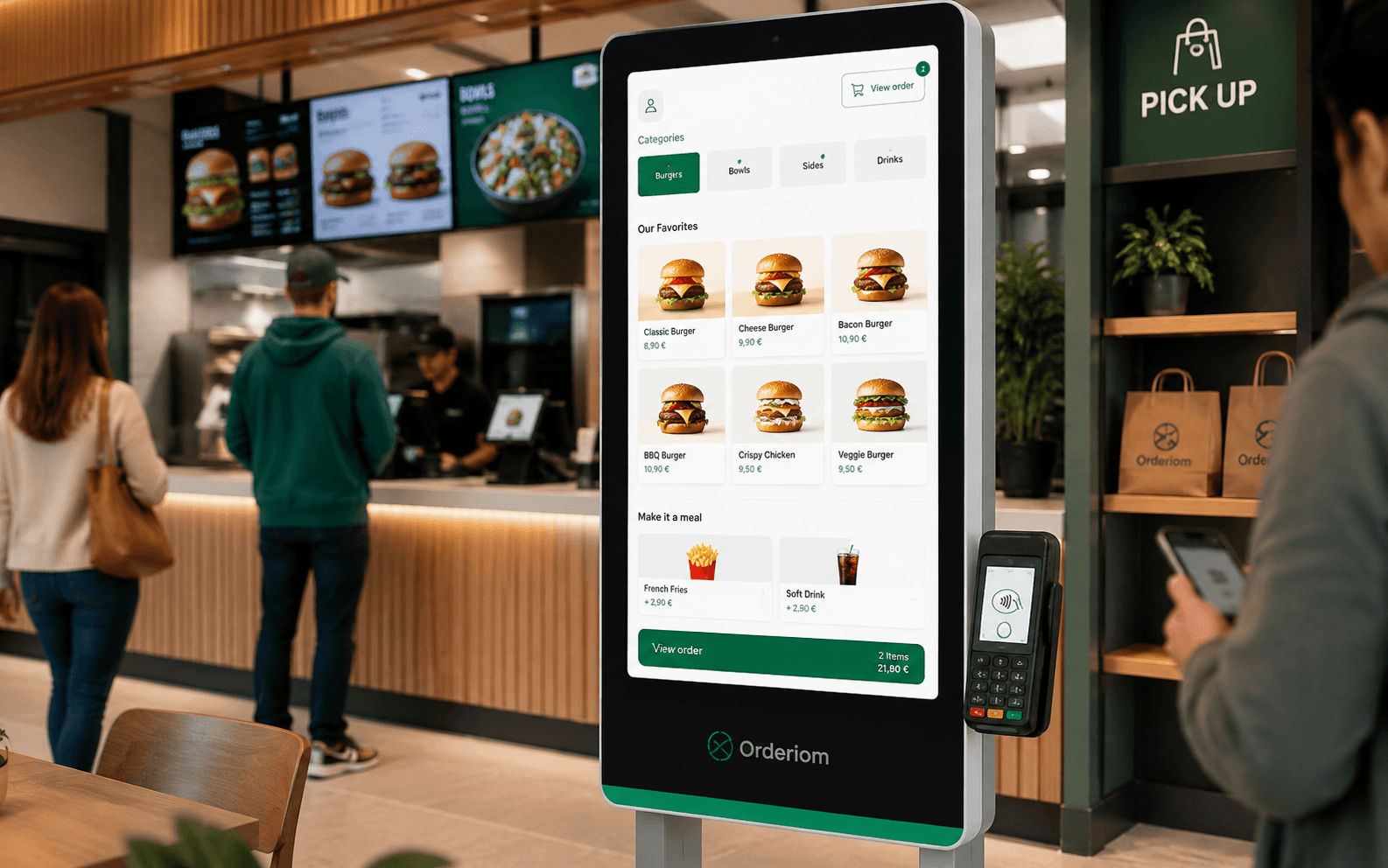
Orderiom can serve as a possible technical platform for digital menus, ordering channels, item management, and statistics and reporting. The solution also lists dynamic pricing and fast price changes as features. This does not replace costing or a legal check, but it can make day-to-day setup easier. Start with one strategy, one channel and one clear key figure. Only add more price logics once the rule works reliably.
Orderiom supports restaurants with digital menus, their own ordering channels, online payments, item management, and statistics and reporting for demand and sales. Visit Orderiom to see what is possible for your price logic, delivery processes and digital orders.