



In a restaurant or café, this question comes up fast: when you hire your first employee, send an invoice to a supplier, or the Finanzamt (tax office) sends you a new number after a move. If you mix them up, you can easily enter wrong details in ELSTER, on invoices or in payroll. The basic difference is clear. Using it in practice often is not, and that is where most mistakes happen.
If you are starting a business, taking over staff or setting up your bookkeeping again, one simple rule is easy to remember. The tax ID (Steuer-IdNr.) belongs to a person and stays the same. The tax number (Steuernummer) belongs to a tax case and can change when your responsible Finanzamt changes. In Orderiom's legal notice (Impressum) you can also see why keeping it apart from other tax identifiers matters in daily business.
Table of contents
- Introduction: the two numbers in daily business
- Tax number vs. tax ID: a direct comparison
- The tax ID in detail
- Where to find your tax ID
- The tax number and its role for your business
- Why it matters so much for restaurants
- In practice: when you need which number
- Hiring employees
- Writing invoices
- Tax returns and starting a new business
- Don't forget the VAT ID (USt-IdNr.)
- Common questions about tax numbers for restaurant owners
- Where do I find my tax ID or tax number?
- How is it different from the VAT ID?
- Must the tax number be on till receipts?
- What happens after a move or a change of business?
Introduction: the two numbers in daily business
A new restaurant owner often has little time to think about numbers. Between deliveries, staff rotas and the first payroll, the question whether the tax number and the identification number are the same seems unimportant at first. That changes when the Finanzamt, the invoice template or the payroll software asks for exactly the right one.
The short answer is no. The identification number belongs to a person and never changes. The tax number is the file or case number at the responsible Finanzamt and refers to a specific tax matter. A simple way to remember it: the IdNr stays with the person, the tax number stays with the case.
Practical rule: If it is about an employee or about you personally, think of the IdNr. If it is about your business, a tax filing or a letter to the Finanzamt, the tax number is what counts.
Restaurants feel this a lot in daily work. New hires, invoices, VAT and letters after a move often happen at the same time. If you use the right number at the right time, you avoid questions and later corrections. In Orderiom's legal notice (Impressum) you can also see why such details are kept clearly apart in daily business.
Tax number vs. tax ID: a direct comparison
In a new restaurant business, it is easy to mix up two numbers. The tax ID belongs to the person, the tax number to the tax case at the Finanzamt. That is the practical difference in daily work.
For daily restaurant work, a simple rule of thumb helps. The tax ID is like a person's permanent ID card. The tax number is more like the case number in the Finanzamt's file. So if you are doing payroll for the first time, registering staff or preparing invoices, you often need to know exactly which number is required.
The tax ID was introduced as a single, nationwide personal number for tax purposes. The BZSt explains this on its information page.
As a restaurant owner, what matters most is how you use it in your business. For payroll, tax forms and letters after a move, the tax number helps assign the case, while the tax ID clearly identifies the person. If you change to another Finanzamt, the tax number can change, but the tax ID stays the same. Sparkasse also describes exactly this difference.
The tax ID in detail

The tax identification number always stays the same. It has 11 digits and does not change when you move, change your name or your marital status. For the authorities it works like a person's permanent ID card, while other numbers mark a file or a case.
Where to find your tax ID
You can usually find the tax ID on documents you already have, for example your income tax assessment, your annual payroll tax certificate (Lohnsteuerbescheinigung) or the BZSt letter that told you the number. If you move to Germany, you get it automatically after you register your address, because it is linked to the person, not to a business. The Lohnsteuer-Kompakt overview describes how this permanent number is issued for tax purposes
Rule to remember for payroll: The tax ID belongs to the employee, not to the company. That is why HR uses it to identify each person clearly.
For a restaurant, this is useful for hiring, payroll and staff files. The tax ID stays the same even when someone moves or changes employer. So it remains the fixed personal identifier in daily business, even when shifts, temporary staff and duties change quickly.
The tax number and its role for your business
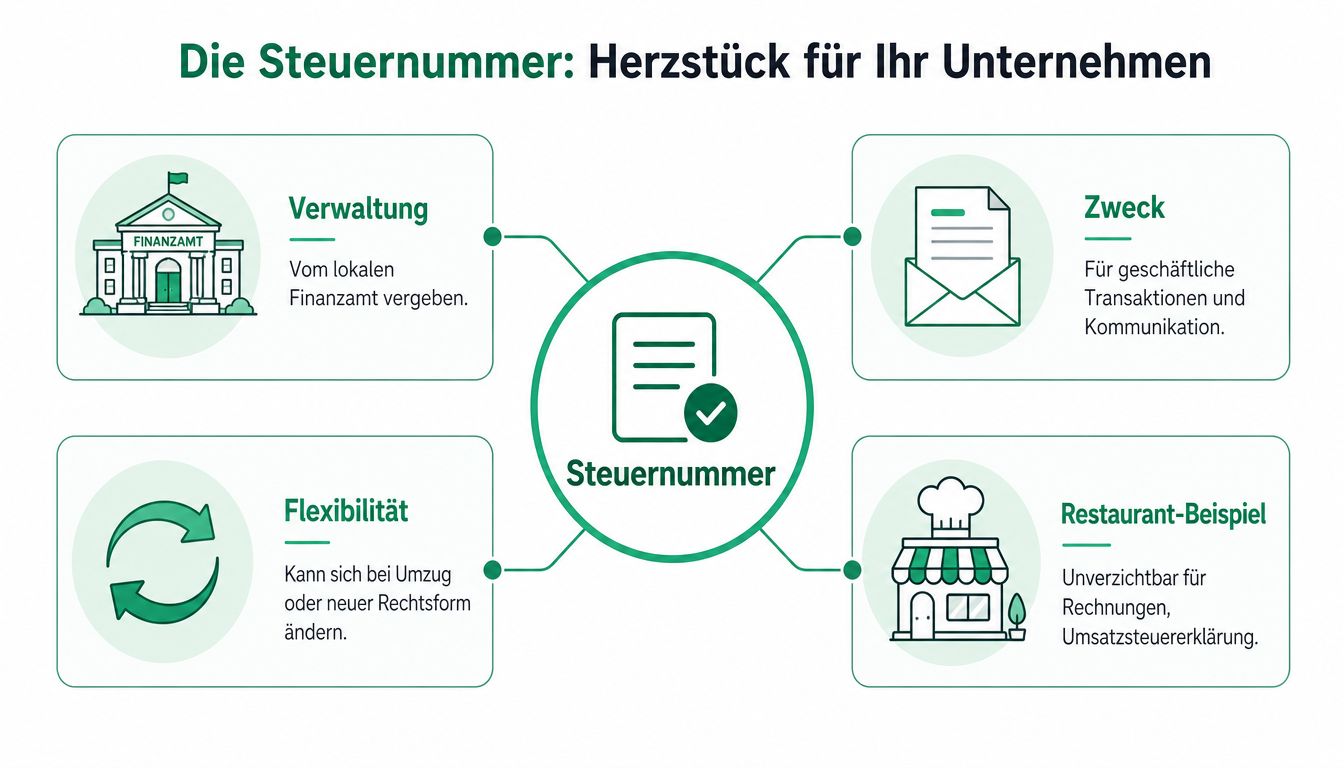
The tax number is your business's working number at the local Finanzamt. It belongs to the company's tax file, not to a person. If the responsible office changes, for example after a move or with another Finanzamt, you can get a new tax number.
Why it matters so much for restaurants
In a restaurant, several things run at the same time, for example VAT, payroll tax and advance returns. The tax number makes sure the Finanzamt assigns everything to the right business. This is especially important for a branch that moves location, because the personal tax ID stays the same, but the business assignment can change.
Practical rule: Keep old tax notices and accounting records safe. After a change of Finanzamt, you often still need earlier records as proof.
So in daily work, every message to the Finanzamt, every booking and every till record should match the right business number. If you run several processes at once in your restaurant, this helps you avoid mixing up old and new cases. For the technical side of your till and your workflows, a POS consultation from Orderiom can also help if you want to set up your processes properly.
In practice: when you need which number
In daily restaurant life, the question often comes up exactly when things get practical. A new head chef starts, the first payroll runs, or after a move the Finanzamt writes to you about new responsibilities. Then it helps to separate them like an ID card number and a file number: each one does something different.
Hiring employees
For payroll, the person's tax ID goes into the records. It helps match the electronic payroll tax data (ELStAM) correctly. The business itself stays registered at the Finanzamt under its tax number. If you employ staff in your restaurant, in service or in the kitchen, keep these two levels clearly apart.
Writing invoices
Your private tax ID does not belong on business invoices. Depending on the case, business owners use the tax number or the VAT ID (USt-IdNr.), if they have one. This is important in restaurants, because invoices are often written at the same time as staff matters and ongoing bookkeeping.
Tax returns and starting a new business
For your income tax return, the tax ID is your personal identifier. For business matters, the company's tax number is what counts. When you start a new business or a new tax case is opened, communication with the Finanzamt uses the business number, not the personal ID.
If you are unsure, ask first: Is this about a person or about the business? This one question saves many follow-up questions in practice.
Don't forget the VAT ID (USt-IdNr.)
For self-employed people and restaurant owners, the VAT ID (USt-IdNr.) is a separate number. It is neither the tax ID nor the tax number, but a separate business identifier for certain invoices and business transactions. The Federal Commissioner for Data Protection (BfDI) clearly points out this practical difference. So the everyday question is always: does ELSTER, the invoice, the payroll or the new business registration ask for a personal number or a business number?
Common questions about tax numbers for restaurant owners
In daily restaurant life, the same questions come up again and again, just in a different form. A clear rule helps you avoid thinking it through from scratch each time. If you keep the numbers apart, you avoid mistakes in payroll, communication and filing.
Where do I find my tax ID or tax number?
The tax ID is often on your income tax assessment, your annual payroll tax certificate or the BZSt letter. You usually find the tax number on tax notices or letters from your Finanzamt. After a move, you may get a new tax number. The old documents are then still useful as a reference.
How is it different from the VAT ID?
The VAT ID (USt-IdNr.) is the business identifier for VAT matters, mainly for invoices to other businesses or for cross-border transactions. The tax ID belongs to the person, the tax number to the business and the responsible Finanzamt. For a restaurant, this difference matters in daily work, because invoices, staff and bookkeeping often run at the same time. The BfDI points out exactly this difference.
Must the tax number be on till receipts?
For guest receipts, what matters most is that your POS system works correctly and uses the right business details. Your private tax ID does not belong there. Check the rules for invoices and receipts with your tax advisor or in your internal processes. For typical practical questions about numbers and processes, the Orderiom FAQs can also help.
What happens after a move or a change of business?
If your responsible Finanzamt changes, you may get a new tax number. The tax ID stays the same, because it is linked to the person, not to the restaurant's location. This mix of one fixed and one changing number often causes confusion, especially after a move or changes in the business.